Washington’s official state gem isn’t a gem at all — it’s a 15-million-year-old fossil forest along the Columbia River
Washington’s official state gem isn’t actually a gem. It’s petrified wood — fossilized tree trunks turned to solid stone over millions of years — and the state legislature made it official in 1975 for a reason most people never learn.
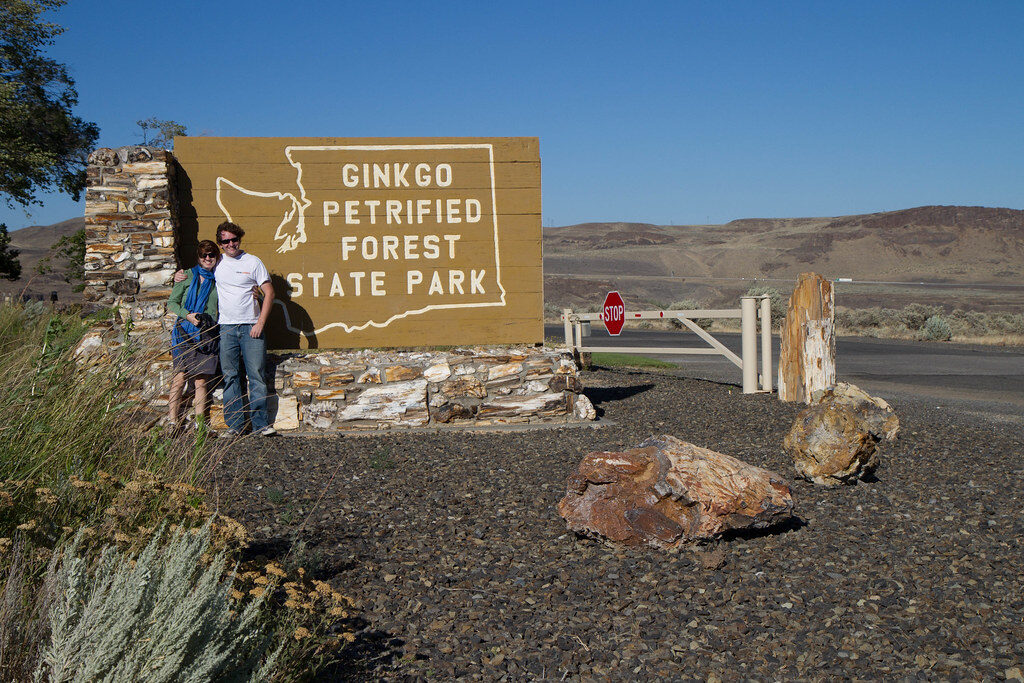
The forest it came from is still there, in a sense, right on the Columbia River at Vantage, about two hours east of Seattle on I-90. Ginkgo Petrified Forest State Park sits exactly where the highway crosses the river — easy to blow past at 70 mph, easy to underestimate once you actually stop.
Psst — we made you a West Coast Adventure Map. Nearly 1,900 of our favorite spots, already pinned, ready to load into Google Maps in two clicks — grab it here.
About 15.5 million years ago, this stretch of central Washington wasn’t desert at all. It was a warm, swampy lowland thick with trees that don’t grow together anywhere on Earth today.
Volcanic ash buried entire trunks where they stood, and groundwater slowly swapped the wood’s organic material for minerals, cell by cell, until stone took its place. Basalt flows sealed the whole thing shut for millions of years afterward.
It didn’t resurface until the Missoula Floods tore through at the end of the last Ice Age, stripping away rock in a matter of days and exposing logs that had been buried since before the Cascades existed.
More than 50 tree species have been identified here, including ginkgo, redwood, sweetgum, magnolia, walnut, and sassafras. Ginkgo is the one that gave the park its name, and it’s the strangest resident of the bunch — wild ginkgo trees survive naturally in only a few mountain pockets of southwestern China today, which makes finding one fossilized in Washington basalt feel like evidence from a different planet.
Highway crews first noticed the petrified logs in the late 1920s, and geologist George Beck organized the excavation that followed. The Civilian Conservation Corps built the original museum and opened the park to the public in 1938, and it became a National Natural Landmark in 1965 — a decade before petrified wood picked up its state gem title.
Walking through it
The easiest way to see it is the Trees of Stone Interpretive Trail, a 1.5-mile loop that leaves 22 species of petrified logs sitting exactly where they were dug up in the 1930s. No glass case, just signage and stone. A longer 2.5-mile loop option winds through the same sagebrush hills if you want more time outside.
The interpretive center also displays around 60 Wanapum petroglyphs, salvaged from basalt cliffs before Wanapum Dam raised the river in 1963 and put the rest underwater. The Wanapum carved several hundred of them along this stretch of the Columbia — what’s on display is what could be pulled before the water came up.
Most people treat Vantage as a bathroom break between Seattle and Spokane. Twenty minutes on this trail might be the most interesting rest stop in the state.
Down at Wanapum Recreation Area nearby, swimming, boating, and camping along the reservoir make it easy to turn the stop into a half-day instead of a pit stop. As a Washington state park, Ginkgo Petrified Forest requires a Discover Pass to park.
Trip tips: grab a rental car to get out here, lock in your hotel before the good rooms are gone, or skip both and book a camper van instead.
Rules and fees change — always confirm current requirements before you go.