
South of Olympia, a Washington prairie is covered in thousands of dirt mounds nobody’s fully explained
South of Olympia, a stretch of prairie is covered in thousands of dirt mounds — each one roughly circle-shaped, spaced out with a consistency that looks almost engineered. Nobody engineered it, and more than a century of research still hasn’t settled why they’re there.
Psst — we made you a West Coast Adventure Map. Nearly 1,900 of our favorite spots, already pinned, ready to load into Google Maps in two clicks — grab it here.
Mima Mounds Natural Area Preserve protects 756 acres of this landscape in Thurston County, just outside the tiny town of Littlerock. The mounds themselves run 7 to 40 feet across and 4 to 7 feet high, and the National Park Service designated the site a National Natural Landmark back in 1966 — one of only 17 in the entire state.
Nobody’s cracked the case, though not for lack of trying. At least 30 documented theories have been floated since 1913, when glacial geologist J Harlan Bretz proposed the mounds were “sun cups” melted into retreating ice. Since then, researchers have blamed frost cracking in the soil, shockwaves from ancient earthquakes, and — the current frontrunner — generations of pocket gophers piling dirt above their burrows.
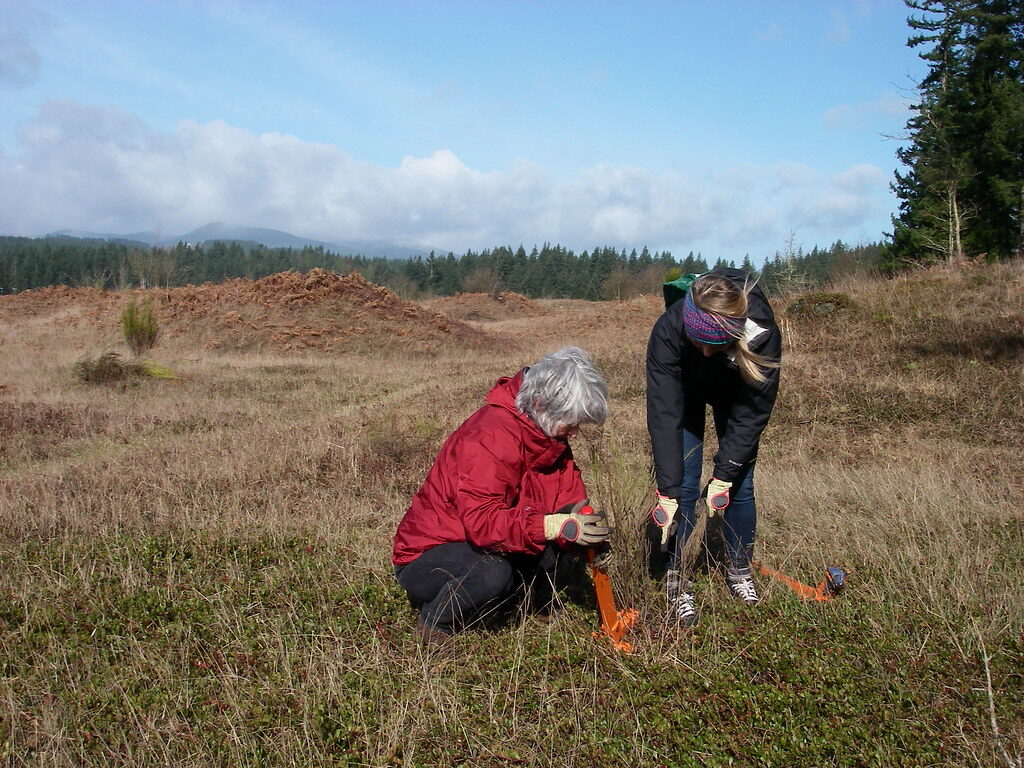
A 2013 study modeling gopher behavior got close enough that one science journal declared the mystery solved. Not everyone’s convinced — that theory requires the gophers to have worked, uninterrupted, for thousands of years, and some researchers think that’s asking a lot of a rodent. The mounds formed sometime in the roughly 16,500 years since the last glaciers retreated from this part of Washington, so whatever made them has had a long head start.
Getting here doesn’t require solving anything. From I-5, take exit 95 and follow Maytown Road about 3.7 miles through Littlerock, then turn right on Waddell Creek Road SW for another 0.8 miles to the parking lot. It’s roughly an hour and a half from Seattle, or about 20 minutes if you’re already in Olympia.
A paved, wheelchair-accessible loop covers the first half-mile and leads to an observation tower — climb it for the best view of mounds rippling out toward the treeline in every direction. Another two miles of gravel trail wind through the mounds themselves if you want a closer look.
A couple of rules to know before you go: dogs aren’t allowed here (service animals excepted), and neither are bikes. This is a Natural Area Preserve, not a park, and Washington manages it to protect a genuinely rare habitat rather than maximize what you can do in it. You’ll also need a Discover Pass to park — $30 for the year, or $10 at the day-use kiosk.
Spring is when this place turns into a postcard — camas and other wildflowers blanket the mounds in blue and purple from April into May, with new blooms taking over as the season shifts. Visit in summer instead and you trade the flower show for dry gold grass, which honestly makes the mounds themselves easier to see without anything else competing for your attention.
They’ve been sitting out there for thousands of years without giving up the answer. Go stand on the tower and decide which theory you believe.
Trip tips: grab a rental car to make the Olympia detour easy, or lock in a hotel nearby if you’re turning this into a bigger South Sound weekend.
Rules and fees change — always confirm current requirements before you go.